


Vision
Insanity is doing the same thing over and over again and expecting different results.
Albert Einstein's famous quote sums up the problem perfectly. Existing problems cannot be solved using the same old ways of thinking. It is therefore time to look at things from a different perspective, rethink problems, and accept options that were previously considered a losing proposition.
The cyclical world and the end of linear growth
We are caught between war and peace, bull and bear markets, and freedom and oppression. With his discovery of cyclical patterns based on the number pi, analyst Martin Armstrong was able to accurately predict economic events long before they occurred. Armstrong's deeper insight is that decisions are made based on trust in governments and the stability of the currency. But the issue of trust can be viewed much more broadly in terms of entire communities and the question of what it actually means to live. The same applies to the cycles on which the entire universe, and thus we ourselves, seem to operate. Ancient writings such as the Vedas (a collection of Hindu texts) speak of the transition from a dark age to a light age. This, too, can be seen as a cycle. Perhaps we are at the transition from one age to the next, when old systems and ways of thinking begin to fail and new ones slowly establish themselves.
We should soberly discuss the question of whether all the ideas that form the basis of national economies and social coexistence are simply an outdated construct. It's about control, fear, and the possibility of replacing them with trust. Because let's be honest: the current approach to control has failed. Economically, humanly, and ethically.
The restart scenario
Rich and poor, man and woman, day and night. These are all obvious opposites, as they are omnipresent and observable. But these dualities, which largely shape our thinking, form a unity or cycle when viewed from a meta-level. One determines the other and thus creates the conditions for the cycle. Some cycles are inevitable, such as day and night, others are currently still a prerequisite for continuity, such as man and woman, while others are avoidable, such as rich and poor.
This is not about criticizing economic systems or political approaches. It is about perspectives, i.e., how we view things and derive simple actions or even highly complex social systems from them. It is about questioning old perspectives without assigning blame and adapting them to current possibilities. It is also about recognizing that everything is a development in which mistakes have been and will inevitably be made.
The society tree
In contrast to ancient social orders, which were structured like pyramids, with God at the top and the people/serfs at the bottom, we should rethink society as a tree. But why? With God or the elite at the top, projecting a supposed role model whose ideal is unattainable, there will always be dissonance between how society should be and how it really is.
The foundation of society is built on a strong, moral network of roots that anchors it firmly in life. This network of roots defines what it means to be human and what it means to be alive. It is something like a compass that guides the direction of actions. This stands in stark contrast to today, where whatever is technically possible and generates revenue is done – regardless of the long-term cost.
Above the roots rises the trunk of society, which derives ideas, developments, and common goals from the moral root system. These are ideas about how economic systems are shaped, which technical developments are beneficial and should therefore be implemented, and which regional needs must be taken into account. In concrete terms, this would mean that the basic moral framework would be very similar, if not identical, across regions. However, regional developments themselves can vary greatly. The company's objectives in Greenland are therefore different from those in the Sahara, due to regional and climatic differences.
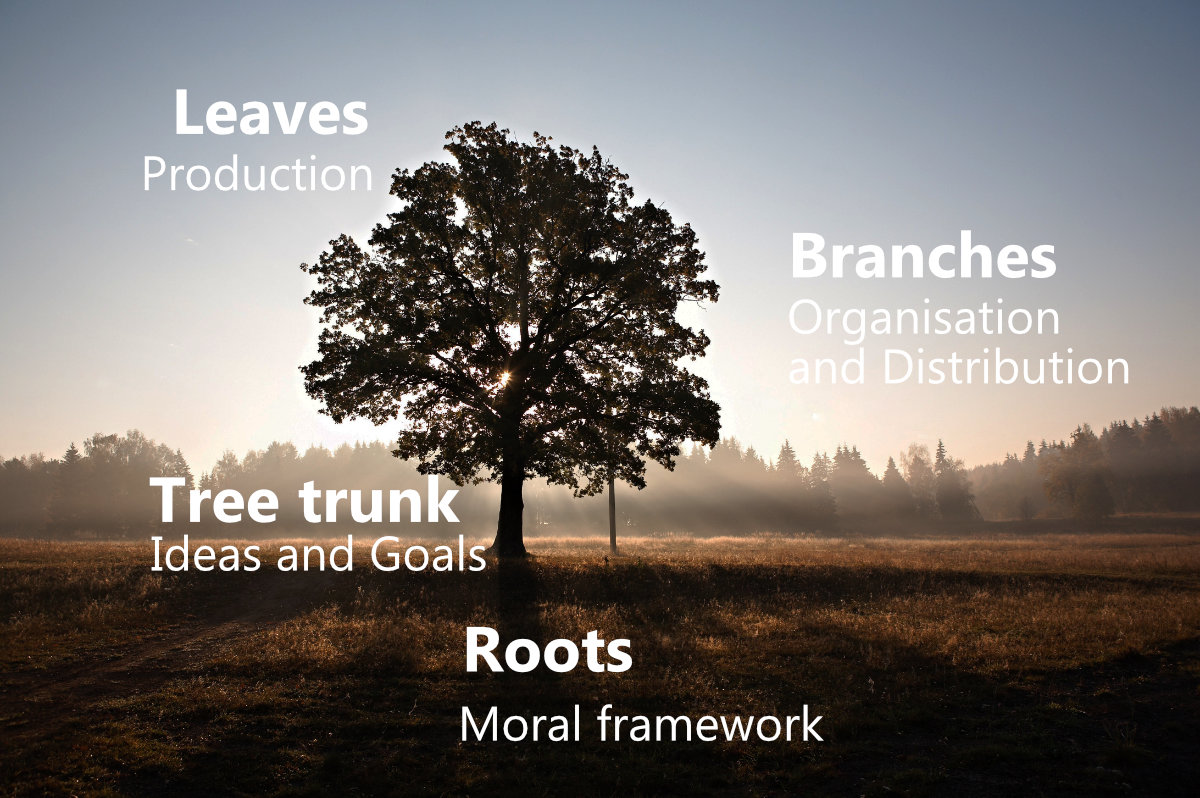
The branches represent the organizations and distribution within society, comparable to what the state is supposed to represent today. These are stable structures that are the extended arm of society's goals and ideas, enabling and shaping them. At their ends are the leaves, which represent the labor force of society. The results of the work fall to the ground and thus provide feedback to society or serve as fertilizer for further growth. It is a self-regulating system that eliminates toxic elements in the long term instead of promoting them, as is the case today, where profit is the only concern.
The big misunderstanding
From a capitalist and socialist perspective, work is an end in itself. This is hardly surprising, as socialism and capitalism are two sides of the same coin. What is profit maximization for one is plan fulfillment for the other. Yuval Noah Harari provides an exciting perspective on the two economic systems in Homo Deus, describing them as information processing systems. While in capitalism decisions are made decentrally, i.e., locally, in socialist systems everything is decided centrally, for example by the party. Decentralized information processing is, of course, much faster than centralized processing. Therefore, capitalism, or rather the market mechanism behind capitalism, will enable faster decisions and be more innovative. This allows the resource of labor, which makes both economic systems possible in the first place, to be used much more efficiently.
However, one fundamental aspect of the concept of work is overlooked: work is a social institution, because people need a purpose and want to have a defined place in life. They want to help shape their lives. However, this is increasingly taking a back seat as conditions in the workplace become harsher. This can be outsourcing in capitalism, combined with job losses and existential fears, or the increasingly rigid system of surveillance and oppression that characterizes socialism.
Work is also one of the places where people interact, develop themselves, and thus form a fundamental part of society, if not the most fundamental part. Cooperation has made us humans successful as a species. Instead of securing our survival individually against an aggressive environment, we formed communities based on the division of labor. Today's division of labor therefore makes perfect sense, even if this is difficult to recognize. It goes without saying that production will always be an inevitable part of work, as the basic needs of the population must be met.
The question of work will be particularly exciting in relation to topics such as Industry 4.0 and robotics. What do we want to automate, and more importantly, what do we not want to automate? The fact that not everything that could be done technically will be done is a result of the moral foundations of future societies. Jaques Fresco postulated the theory of a resource-based economy in which machines take over heavy and dangerous work and humans devote themselves to aesthetic activities. While this is a good idea in principle, it ignores those who do not want to or cannot engage in aesthetic pursuits. The author takes Fresco's idea so far as to suggest that dangerous work and work that no one wants to do should be taken over by machines. Recognition for these difficult jobs will be important during the transition period, but also afterwards, once automation is in place. Just as jobs that bring in a lot of money are recognized today, work in palliative care or in the sewers must be given social recognition. Just like a TV star or a top athlete today, for example.
The armed forces already operate on a similar concept today. While the pay for the risk is relatively modest, soldiers receive a second currency, honor and recognition within the unit. A similar system ensures that unpopular jobs are carried out until they are automated, if indeed they are to be automated.
Class struggle 2.0
Societies are divided into upper, middle, and lower classes. The upper class wants to secure its position, while the middle class wants to rise, and the lower class is actually only concerned with survival. What sounds like a purely capitalist problem also affects socialist systems. Here, society is divided into the party and the working class, and the common enemy is the dissident. While the party cadres live in luxury, the comrades must be careful not to become dissidents, because denunciation is omnipresent. What socialism solves with denunciation and the gulag, capitalism does somewhat more subtly with income. So these are two sides of the same coin, each driven by ideology. They are competing products of the past millennium. Adam Smith, Karl Marx, and many others provided answers to the questions of their respective times. But time has not stood still, although their intellectual approaches have.
Plan the economy instead of planned economy
The socialist dream of being able to plan people to measure from the Politburo is doomed to failure, as any creative spirit is denied from the outset. In addition, civil servants who think in lockstep are supposed to predict and plan the dynamics of life for several years ahead. The history books are full of examples of how planned economies do not work. The USSR, the GDR, and, more recently, Cuba.
Nevertheless, socialism also has interesting aspects, namely social cohesion and the predictability of production. Socialism achieves social cohesion through sheer necessity due to scarcity and fear of political persecution. The predictability of production is achieved by defining a multi-year plan, which, however, is rarely achieved due to scarcity. Social cohesion can also be achieved with a common goal. This is demonstrated by the realistic conflict theory of social psychologist Muzafer Sherif. In an experiment that is now considered ethically questionable, he showed that existing conflicts can be reduced and new common ground found with a common goal. It is known as the Robbers Cave experiment.
Nowadays, IT makes it very easy to plan production. Take a payback points system, for example. However, the data is not used to promote products to customers in a more targeted manner or to evaluate social credit, but to optimize production. It should be clear that this turns the current economic system upside down. It would no longer be necessary to use advertising and PR to suggest needs to people and thus boost sales of interchangeable products. In this case, production would be based on real needs, which can still be controlled via public communication, as the advertising industry has impressively demonstrated so far. Advertising, or public communication in general, would be used in this case to propagate the desired values and perspectives, because people largely follow the guidelines set by the authorities. The Milgram experiments provide a striking example of this.
This should set off alarm bells for data protectionists. After all, all the data that would be collected could also be used for surveillance. Minimizing this incentive naturally requires a solid value base! IT is just a tool, like a hammer, but it is not evil per se. You can use a hammer to drive in a nail or hit someone on the head. The hammer is not to blame. But what controls the hammer is the intention of the person using it.
Value basis
Growth above all else is the current credo of the economy, because this is the only way to secure jobs. The fact that environmental destruction and various other crimes are ignored in the process does not bother many people. The fact is, however, that every action should be guided by a moral framework. Without this framework, actions, or in a broader sense, the entire economy, become an end in themselves, where anything that is profitable can be done. Current economic systems ensure that the majority of people behave like animals that have been cornered. They are geared towards attack and are (passively) aggressive. But where does this come from?
In the book Willpower by Baumeister and Tierney, compare the duration of a substance's effect to the length of the addict's thought cycles. The length of the thought cycles correlates with the duration of the substance's effect. Put simply, the addiction must be satisfied now, regardless of the long-term effects. The same applies to the income situation of most people. The bills have to be paid now, so short-term measures are taken to obtain money that are harmful in the long term, such as corruption, crime, or simply a job that is too stressful.
Survival, whether real or social, justifies actions that are strategically poisonous. And as long as we are dependent on a pay check, nothing will change. Unless people have the security of knowing that their survival is assured, i.e., that their income is secure. At first glance, this sounds like an unconditional basic income, but it is not. It is about an economic and monetary system that offers long-term stability and thus defuses the struggle for survival, but does not bring society into line with socialism.
The question remains: why should people do anything at all if the pressure is taken off? First of all, the concept of work has degenerated into a struggle for survival, whereas work is actually an essential part of social coexistence. Another perspective is self-interest. People are intrinsically motivated to get the best for themselves. However, this self-interest can be guided by moral values – either by the principle of “after me, the deluge” or in more socially acceptable directions.
Make mistakes 2.0
No matter who you are or what level of education you have, things will go wrong at some point. Whether this is due to misinformation or misguided emotions is irrelevant at first. That is why it is important for systems, whether technical or social, to rely on passive safety. This means that they are fault-tolerant and, in extreme cases, ensure that self-regulation kicks in before things reach breaking point. What a culture of error is for a society, self-shutdowns in case of overload are for technical systems. Technically, this is made possible by the appropriate design of the systems. Socially, we achieve this by establishing behavioral routines that acknowledge errors and reward reporting and correction. This leads to a completely new mindset in which people no longer have to cover up their mistakes or blame others, but instead grow with their mistakes and learn from them. In short, it's okay to make a mistake. But it's best to make it only once, without repeating it constantly in the hope that it will be better next time.
Growth, growth above all else
Our current social systems revolve purely around the economy. What matters is not what is good for society or people, but what generates revenue and creates jobs. We can therefore simply refer to economic systems. This way of thinking is not even wrong, as economic systems depend on growth and the growing population must also be provided for. Capitalism is currently competing with socialism. While capitalism appears to have defeated socialism with the collapse of the USSR, it is abolishing itself in the long term by creating massive inequalities. The ever-widening gap between rich and poor is caused by the compound interest algorithm of money, which is also behind the constant demand for more growth. Wealth and debt multiply almost automatically, but someone has to physically create this growth...
Currently, people go to work trusting that they will receive compensation tomorrow for the work they do today. Money makes this possible. While there is a persistent belief that money must be backed by something, such as the former gold standard for the dollar, the real backing behind it is always trust. The trust that colorfully printed paper with minimal intrinsic value can be used to purchase tangible assets worth many times that amount. Because of this trust, people get up in the morning, go to work, and invest in the future. Until the next crisis of confidence, which ends in a crash. Economic growth is needed to delay this crash for as long as possible. When the economy is booming and consumption is brisk, cash flow is healthy and reinvestment follows. The lifeblood of the economy is in motion, money.
One lever for keeping the economy humming is planned obsolescence. Goods are produced in such a way that they break down prematurely and something new has to be purchased. In the past, this was achieved by using inferior components, such as undersized transistor, but today it is simply done using software. This is very easy to see with cell phones. Once the contract period ends, there are no more updates, which makes the device insecure and unusable. So a new one has to be purchased and the economy booms again. However, the fact that this wastes massive amounts of resources and labor is actually desirable in the context of economic growth. The growth paradigm is driven on the one hand by population growth and on the other by our current financial system, which relies on compound interest as a mechanism for distributing money.
Compound interest
Money is the equivalent value of a good or service in an economic system. It serves as a universal medium of exchange and thus ensures the distribution of goods. However, it has a unique characteristic that no other commodity possesses: hoarding money incurs hardly any storage costs. It can be stored long-term without losing value, at least from a physical standpoint. A ton of apples will rot if stored for too long. The equivalent value in money can be stored for long periods of time without any problems except inflation.
When someone stores money, i.e., takes it out of circulation, this hinders the exchange of goods, as there is not enough money overall to ensure the turnover of goods. The paradox is that the person who holds back the money also collects a fee, interest, to put it back into circulation. Interest itself is not only a lending fee for the money, but also, via the compound interest effect, a mechanism for redistributing money to those who lend it. In the long run, capital is concentrated among lenders, as wealth grows exponentially through interest and compound interest. This means that the growth curve rises slightly at the beginning, but becomes steeper over time and thus grows more and more the longer the loan runs.
Through the creation of bank money, the money supply is constantly expanding via lending. The creation of bank money means that the bank is allowed to expand the money supply when there is a corresponding need. For example, when someone signs a loan agreement. However, this is only possible if the bank actually owns a certain percentage of the borrowed money and this is deposited as collateral, which is called the minimum reserve. Money is created out of thin air, so to speak, but a certain amount of real money must always be available. What is necessary in the short term to generate economic growth creates money monopolies in the long term, which can exert disproportionate influence on the economy and politics.
The higher the interest rates, the stronger the multiplier effect of money. As the amount of money in circulation increases over time, the value of money decreases and investment assets become more expensive. This is because the amount of money is the equivalent value of the investment assets available on the market. With the expansion of the money supply, the balance shifts toward increasingly expensive investment, asset prices rise.
Every product and service contains interest components. These arise from borrowed money used in production or from the interest that the company loses when the money is invested in the company instead of being given to the bank and earning interest. The more capital-intensive a company is in order to offer a product or service, the higher the interest component that is always included in the price.
Wealth also means new debt, as capital owners want to put their money to work for them. However, money does not multiply on its own. Assets can only grow when a person pays off a loan. So it is always people who, through their labor, ensure that money can multiply. This means that new ways of granting loans must be found compulsively. This results in a return flow to the investors, who thereby accumulate even more capital. It is a never-ending cycle. The social impact on everyday life remains invisible as long as the economy can keep up with the exponential growth of interest rates. However, since an economy can only grow linearly, i.e., at a constant rate, and never exponentially, it is only a matter of time before the effects become visible. The constant demand for more economic growth only alleviates the problem in the short term, but strategically adds fuel to the fire. In the past, these monetary systems were necessary to ensure the distribution of insufficient goods. Thanks to technological advances, this shortage no longer exists today -at least for basic needs - but is merely being artificially maintained by the continued existence of the antiquated interest-based money distribution mechanism.
Several steps are necessary to achieve a sustainable economy without the interest trap. However, these steps take time, because the people who lose out in the system have no lobby, and those who gain have no interest in changing anything. Everyone in the current system is driven by fear of possible scarcity or expectations of advantage and therefore tries to gain the suggested advantage. The distribution system itself is the problem, not the people who unsuccessfully try to control it.
A new approach would be to leave everything as it is, with the exception that the function of interest is reversed. Anyone who still has money left at the end of the month would then have to pay a levy, as this person is keeping the money out of the economic cycle and thus hindering it. A penalty similar to that for illegal parking. This is the principle of free money as postulated by the merchant Silvio Gesell. Since most payments are now made electronically, the changeover would be easy. Such negative interest currencies are not a utopia, but have already existed. For example, in Wörgl during the Great Depression, in what is known as the Miracle of Wörgl.
Resource-based economy
Money disappears, but everything else remains as before. Companies continue to produce goods, distribution takes place as usual, and the administration controls the flow of things. Everything continues as usual, except that no one handles money anymore. Each person contributes what they are willing to contribute. The Earth's resources are considered a common good that belongs to everyone and no one. The economy ensures the framework for a dignified life for all people. This is the principle of the resource-based economy according to Jacque Fresco. It sounds somewhat utopian, and it is, because Fresco's utopia envisions machines doing the heavy work and people devoting themselves to aesthetic activities, which will not work. There will always be people who cannot or do not want to engage in aesthetic pursuits. In times of increasing automation, however, this utopia could quickly become reality, because machines are on the rise.
Politically, however, little will change here, because politics is there to maintain the status quo. On the other hand, the problem also lies with people, who prefer to accept a quick answer rather than embrace new ideas. When social pressure and the suffering of the population are great enough, quick answers can easily lead to a new kind of extremism. On the other hand, one should never underestimate the transformative power of a real crisis. Especially when people realize that the emperor has no new clothes.
Motivation
Today, profit is the motivation behind all entrepreneurial activity. In order to generate this profit, numerous products that are not actually needed are produced, and marketing creates the demand. This is a waste of resources.
The earth has limited resources. The cornerstone of public supply is resources and their distribution, not money. In a resource-based economy, the first step is to take inventory of which resources are available in sufficient quantities and where there are actual shortages. This data is collected in a publicly accessible database where it can be evaluated. Based on this data, what is necessary for supply is produced.
This separates the concepts of work and survival, as basic needs are met. This creates space for creative development and thinking, because the only real shortage that currently exists is a lack of creativity and innovative spirit. Based on this concept, completely new solutions are possible. Environmentally friendly technologies that have not been profitable so far are then seen in a new light. In a resource-based economy, the idea of sustainability comes into the spotlight. It then becomes more interesting to create technologies, operating methods, and buildings that are environmentally friendly, useful for people, and efficient, rather than simply being cost-effective. It also follows that mindless, monotonous work is automated, as far as the current state of technology allows and as desired. Research and business go hand in hand, providing solutions to improve everyone's living conditions. Until automation is advanced, people around the world will still be obliged to work to ensure supplies. However, they will then have a different motivation, namely to create progress and improve living conditions, rather than simply accumulating money or making ends meet.
A resource-based economy does not mean that there is nothing left to do - quite the contrary. There is a lot of work to be done, especially in the transition phase from current economic systems to a resource-based economy. However, this work does not have to be done as quickly as possible in order to generate capital, but rather gradually. The idea behind this is to create an economic system that serves people and does not enslave them again. There is a lot of work to be done here, especially on an intellectual level. As already described, we need a new set of values that people can use to guide their actions. But what motivates people to do the necessary work when food and housing are guaranteed?
Throughout history, individuals who have made a difference and brought about progress have not done so primarily to maximize their personal gain, but rather to solve existing problems and bring about improvement. So what drives the masses when they are not forced to work by scarcity (of food, housing)? The will of the individual to make a difference and bring about change. It is our creative spirit as human beings to take action and shape the world. And, of course, not everyone will want to participate. This is also not the case in today's economic systems. A person who is intrinsically motivated achieves much more than a large number of people who only work for money.
This results in a (working) atmosphere that is more conducive, productive, and peaceful than today's. New incentives to work would then be progress, improvement, and self-fulfillment, as well as the elimination of deficiencies and the urge to express one's own creativity. The idea that the population would just sit around idly and no longer accomplish anything is absurd. The incentive to work is then the work itself, no longer a few colourfully printed pieces of paper that are necessary for survival. The motivation to create and make a difference is intrinsic. Today, however, attempts are made to stimulate this motivation extrinsically through scarcity. The average worker is therefore motivated accordingly.
Change
The management of the coronavirus crisis revealed some striking features, as Paul Schreyer describes in Chronik einer angekündigten Krise (Chronicle of a Crisis Foretold). For example, that in extreme cases, trained behavior can be automatically reeled off, similar to military drills. Crisis management clearly demonstrates the power of published information and authorities in everyday life. The majority of people base their behavior on a role model they trust. This is a good thing, because historically, decisions that were made always had to be implemented. Just as there is a queen and many workers in the animal kingdom, we have the elites and the people.
The situation becomes critical when key positions are held by people who are unable to make long-term decisions. The brain research team led by Tali Sharot at University College London has found that around 80% of all people suffer from unrealistic optimism without necessarily being aware of it. This phenomenon refers to a malfunction of the frontal lobe during information processing. Affected individuals are very reluctant to adjust their worldview, regardless of the evidence presented. Using magnetic resonance imaging, the researchers found that unrealistic optimists use the entire capacity of the prefrontal cortex to distort reality. Classic examples are conspiracy theorists and coincidence theorists, as Schreyer so aptly points out. Where some see evil intentions and conspiracies everywhere, others dismiss the most banal connections as coincidental, even to the point of naive do-goodism. Both are united by unrealistic optimism. This means that approximately 80% of people are incapable of making strategic decisions. Presumably, this also includes approximately 80% of the current elites and decision-makers.
When some people make incompetent decisions and others carry them out unquestioningly, this spells potential disaster. Viewed from another angle, around 80% of people need a solid worldview to guide them and enable them to act. Dr. Sharot's findings are particularly exciting when viewed through a propagandistic or educational lens. If approximately 80% of people are hardly able to change their formed worldview, this explains the indoctrination efforts that regimes undertake very early on in school. In educational terms, this would mean that change begins in kindergarten, because a large proportion of people will no longer be able to deviate from the worldview they have been taught and will thus be the change themselves – whether intentionally or unknowingly.
This becomes interesting when Ellul's propaganda is taken into account. In his seminal work, Ellul defines that victims once infected with propaganda will always seek out new propaganda when the current one collapses, because adopted propaganda explains the world as it should be and thus avoids unnecessary thinking and negative emotions. Decades ago, Ellul described in more drastic terms what Sharot recently confirmed in an MRI scan.
This is where the coronavirus crisis comes into play. Within a few months, mass communication conveyed the supposed danger of COVID-19 to a large part of the world's population. From shock and paralysis to fear and a state of emergency due to the virus, all of this was made possible by targeted communication, as the majority of people were accustomed to trusting established institutions and governments. This trust was cultivated very early on during childhood and later in school and education.
Accordingly, it is also possible to change the world with a newly designed information and entertainment program. Socially beneficial role models and behavior patterns in films and TV shows, critical contributions, and a culture of discussion. Mass communication works, regardless of the content being conveyed. Fear has delivered very quick results in crisis communication. Hope may not work as quickly as fear, but it is more beneficial. But why adapt media content at all? Society is a team sport. No matter what position you play, you will always be confronted with people whose thoughts and actions are inspired or indoctrinated by media-conveyed content.
Whether the theory of unrealistic optimism is correct can be empirically verified by looking at indoctrination in authoritarian systems such as the GDR. While children were placed in state care as early as possible so that their parents could work, a desired worldview was instilled in them at an early age. As a result, many grew up to be well-behaved, conformist GDR citizens who believed in the system.
What initially sounds like a problem with socialism is, in principle, happening everywhere. These are simply narratives, i.e., stories that provide people with a desired framework for action and thinking according to which they should act. Once this framework of thinking has been adopted, it is hardly ever questioned. Instead, people simply act according to it as if it were their own deep convictions, which is ultimately what it is. What is classically understood as indoctrination is based on the mechanism of unrealistic optimism.
A completely unrealistic thought – reason
People entrust authorities with solving almost all problems and expect them to be able to do so. This may work on a small, manageable scale, but in established social systems, this is only true to a limited extent. But why do authorities have to intervene more and more in people's lives and resolve issues that are none of their business? The state is there to create the framework conditions, but nothing more.
For unrealistic optimists, this is probably heresy, as belief in authority is deeply ingrained. But many people are oversimplifying things here. It's always great when a third party is to blame. Since you haven't made any decisions yourself, you don't have to take responsibility for anything, but you also relinquish all control over your own life. And here, the author believes that we should try a completely revolutionary approach: making our own decisions and using reason. At first, it sounds shocking that we should decide fundamental things for ourselves and, in the worst case, also have to take responsibility for them. But this is where we come full circle. The current approach of outsourcing decisions to the authorities is socialist in nature in terms of information processing and therefore too slow. Central authorities are supposed to resolve problems locally, but by the time they have made a decision, the problem is no longer acute or the damage has already been done. When decisions are made to the best of one's knowledge and beliefs, the decision-making processes are much shorter and problems can be solved more quickly.
A culture of error minimizes problems and motivates people to get involved instead of protecting themselves against everything and everyone, as has been the case up to now. Learn from error and improve. A growing portion of the working time is used to solve problems rather than hide them. But that requires trust, courage, and openness. The openness to accept mistakes and the courage to make them. As long as you learn from your mistakes and don't repeat them constantly, the chances of achieving long-term improvement are much better than sticking to the familiar and remaining stuck in old routines. Of course, not everyone will decide everything for themselves overnight. A certain proportion of people will emerge who want to take over the decisions, as is the case today.
Another-ism?
Does all this sound a bit to idealistic so far? Perhaps, but perhaps a meta-perspective allows us to look at things in a new light and thus arrive at different conclusions. Keynes' “invisible hand” of the market, i.e., the self-interest of the individual, really does exist. We are trained by natural selection to survive, and the best genes prevail and reproduce. It is a battle of the genes. Historically, this all made sense in an environment characterized by scarcity. Today, however, we have reached a level of technology where shortages of basic goods have been largely overcome, at least in developed countries. But the natural behaviors of (profit) maximization are increasingly coming up against ethical boundaries. How far are we willing to go as individuals or as a society to enforce abundance in one part of the world through the exploitation of other parts of the world?
This brings us to a philosophical problem that cannot be contained by national borders. Every empire was built upon exploitation or slavery, and this is still the case today. However, we now have the problem or opportunity to view the issue in the broader context of the planet. An opportunity to develop global solutions that make escape routes unnecessary and render wars pointless. A problem, because the effects of neo-imperialism can no longer be covered up, as information still flows freely on the internet. That is, if it is still noticed amid the myriad of distractions that the internet offers.
There have been and still are many people, movements, and approaches aimed at steering the world towards a better direction. But what exactly does better mean? And better for whom? Once basic needs are met, new, suggested needs arise. Many of these are drummed into people in order to keep the current economic system running. But only a small proportion of people benefit from this, and they have no interest in changing anything. The majority of people are simply too distracted, too clueless or apathetic, or too preoccupied with the struggle for survival to even ask these questions. So things will continue this way for the time being, until new forces appear on the world political stage and demand a larger share of the pie, which will lead to tensions.
This is where the question arises: is this what we want?
Probably yes and no, since most people accept things as they are. The tensions that arise lead to conflicts and war, and eventually a new order may establish itself. The catch is that today we have options for mass destruction that could bring the world to the brink of disaster. Or to put it more simply: the fight for resources is pointless, as are the wars waged for them. We need a new understanding of what it means to be alive and to manage the resources on this planet. We must realize that all people want to survive and build systems accordingly that ensure basic supplies. We must also realize that natural selection lies dormant in every cell, geared toward survival and asserting itself. We do not need a new utopia; we need a realistic foundation that takes natural conditions into account and pacifies them.
Empires will continue to migrate, leaving a trail of devastation in their wake. We need a new enlightenment and education, not happy consumer slaves. Not consumerism as a must, nor idealism as a must, but reality-based approaches that are transparent and open to questioning. Presumably, this will not happen on its own, nor overnight. The tragic realization is that most people only learn through pain, if they want learn at all, because they are very reluctant to leave their comfort zone. If these questions should be asked in the future, it probably will only be after massive pain in the context of global crises.
Outlook for the future
We can continue as usual, but then we shouldn't be surprised if we provoke similar results to those recorded in the history books. The problem is that belief in authority feels so normal that it is not questioned. Perhaps we as humanity need to finally reach puberty in order to rebel against existing authorities, without this time bashing each other's heads in and burning everything down, only to plunge back into the next cycle of economic miracle and crisis of confidence.
We are now at a crossroads and should soon make a decision about how to proceed. But to do that, we need to start talking to each other instead of about each other. If we outsource the decision to the authorities again, the path is already mapped out, because they are interested in staying in power. If we dare to ask questions and take matters into our own hands, the future may be uncertain, but it will be much more promising. Technology could enable new forms of society and fundamentally change the way we live. How do you want to live tomorrow?